Trump’s final midterms will probably bring mixed results
Republicans will almost certainly hold on to the Senate, but are likely to lose the House - though the Democrats’ stage 4 Trump Derangement Syndrome could make that a long term benefit to Republicans

We’re amazingly already more than 1/3 of the way from the last presidential election to the next one. Right now the 2028 Republican nomination appears to be Vice President Vance’s for the taking, much like it was for Bush Sr. in 1988 and the Democratic nomination was for Gore in 2000. The other two vice presidents of second term presidents in my lifetime - Cheney and Biden - were never considered likely to become president, which on a side note is part of the reason that no one actually believes that Biden received 81 million legal votes.
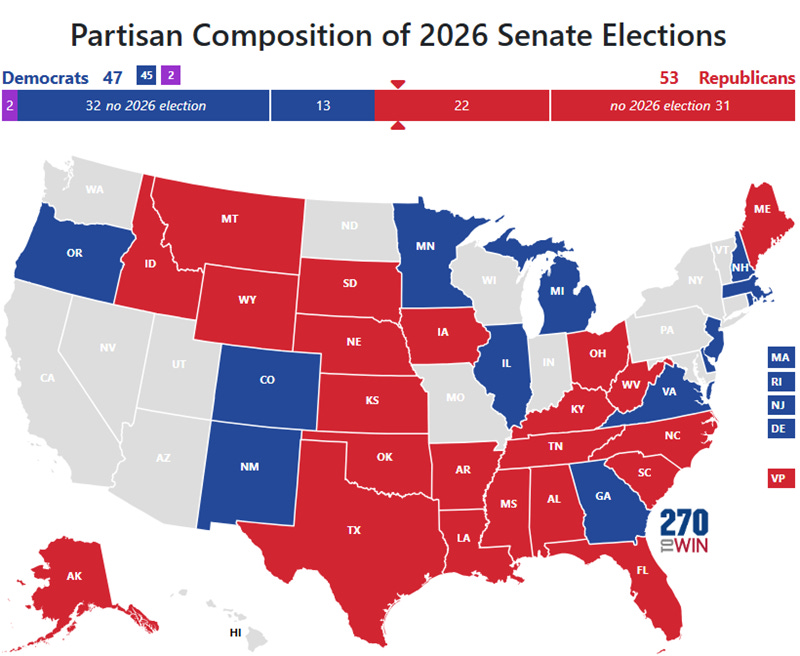
But before we start focusing on 2028, we need to focus on 2026. For Republicans, the midterm elections aren’t likely to be a disaster, but aren’t likely to be great either. They will almost certainly hold on to the Senate; they hold a 53-47 advantage and currently only two seats - Maine and North Carolina - are considered flippable for the Democrats. Furthermore, at least four states appear to be flippable for the Republicans - Georgia, Michigan, New Hampshire, and even Minnesota in the aftermath of the recent scandals there.
Keeping the House is going to be harder. The Republicans have only a 220-213 advantage, and when we’ve had a new president in recent decades, the other party has typically gained about 20-30 seats in the next midterms. But with the heavy gerrymandering that both parties have done in recent years, it’s unlikely that either of them will make that kind of gain - or have more than about a 10 seat advantage - in the foreseeable future. On a side note, that will probably result in extremely heavy spending by both parties in the few districts that are still considered competitive - only about 25 now.
With the Senate apparently out of reach for the Democrats, it’s probable that they will put a disproportionate amount of effort into the House, and campaign on blocking the Trump agenda during what will be his last two years in office. That is likely to work, at least to a large extent. Since Trump was re-elected, Democrats have tried to turn every election into a referendum on him, and have generally done very well with that strategy.
Clay Travis and Buck Sexton gave a particularly concerning statistic shortly after the Democrats comfortably won last year’s Virginia and New Jersey governor elections - 600,000 Trump voters did not vote, while Democrats had very high turnout, amid campaigning that heavily emphasized Trump. Clay and Buck interpret that as many Trump supporters not voting when Trump is not on the ballot, but many Trump detractors voting anytime they perceive an election as a referendum on Trump.
In addition, the Democrats did well in 2018 and 2020, and avoided their expected heavy losses in 2022, because of far superior get-out-the-vote efforts - heavy emphasis on early voting, and on ballot harvesting drives that targeted low propensity voters. Trump and the Republicans finally learned their lesson and adopted those tactics in time for 2024; reversing their previous emphasis on only election day voting. Then RNC co-chairs Lara Trump - his daughter-in-law - and Michael Whatley deserve a lot of the credit for that, as they did a great job promoting their Protect the Vote organization. That’s part of the reason that I’m so enthusiastically cheering for Whatley, who is now the Republican Senate nominee in the important North Carolina race.
Trump must get Republicans as fired up to vote this year as they were two years ago, and make appearances with the Republican nominees in the critical House districts. He has tens of millions of supporters who will vote if he urges them to. And the new party leadership must continue the heavy promotion of Protect the Vote.
One thing that should help the Republicans is that the state of the country is overall much better since Trump returned to office. The economy is improving and should be even better by election day, the southern border is secure, crime is sharply down, and we once again have a president who is not only mentally competent, but also puts America first and is feared by leaders of countries that hate us and want to destroy us - a much welcome contrast to having an Alzheimer’s patient who other countries laughed at while the mainstream media here in America was trying to cover up his mental incompetence.
As long as the war in Iran is over quickly and no major unforeseen crisis happens, it’s unlikely that there will be much increase in anti-Republican sentiment between now and the elections. The Democrats’ demonization of ICE does not look like it’s going to give them much long term political gain.
We’re 233 days away from election day. A lot can change between now and then, but right now I think the most likely result is that the Democrats gain control of the House by a small margin. That would not be ideal for Republicans in the short term, but it would be far from a worst case scenario, and could benefit them in the long term.
It would mean that Democrats could stop Trump from getting any important bills passed, but he could still get his appointments confirmed - judicial and otherwise. And I believe that in the course of controlling the House, the Democrats would alienate many voters with their stage 4 Trump Derangement Syndrome.
I knew from the start that Democrats passionately and irrationally hated Trump, but I did not realize how bad it was until they started their second impeachment of him when he was going to be out of office in just a few days. Their hatred for him since then has only intensified, and I believe that if they control the House for the next two years, they will continually impeach Trump; showing much more interest in trying to humiliate a lame duck president than in helping the people who they claim to care about so much.
That would likely be a big turn off to swing voters, and by 2028 the effects of the tax cuts in last year’s Big Beautiful Bill should have the economy running on all cylinders. And as the Democrats’ dominant message for the last 11 years has been simply hating Trump, it remains to be seen if Democrats will continue to vote in such high numbers when he’s gone. Those factors would probably result in Vance being elected president and the Republicans taking back the House.
Then, starting in 2032, it’s fortunately going to be harder for Democrats to win presidential elections, as blue states are expected to lose about eight electoral votes after the 2030 census. One good thing about COVID tyranny is that it drove millions of people from blue states to red states.
Regardless of the results of this year’s midterms, the Republicans need to work hard on passing the best election integrity laws that they are able to, and on getting large turnouts every time. But as long as they don’t shoot themselves in the foot - which they have done more than a few times over the years - they should be in fairly good shape for the foreseeable future.